
Water Scarcity & Data Centers: Optimizing Cycles of Concentration
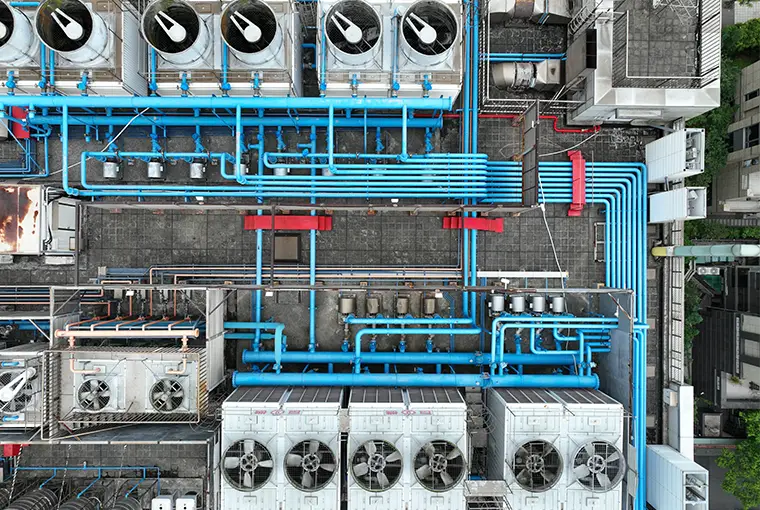
The explosive growth of data centers is creating unprecedented demand for power, infrastructure, and cooling. At the same time, many facilities are operating in regions where water availability is becoming an increasingly important concern.
For data center facility managers, this creates a difficult balancing act. Cooling towers must reliably reject enormous heat loads, often around the clock, while operators are under increasing pressure to conserve water and reduce operating costs. Simply cutting water use without understanding cooling tower chemistry can create scale, corrosion, biological growth, and ultimately reduced system reliability.
One of the most effective ways to improve cooling tower water efficiency is to optimize cycles of concentration.
For data center operators looking to reduce water consumption without compromising mission-critical cooling, the priorities are clear:
- Understand how cycles of concentration affect makeup water and blowdown.
- Determine how far your system can safely increase its concentration cycles.
- Maintain precise control of water chemistry and conductivity.
- Eliminate unnecessary water losses caused by leaks, overflow, and inefficient equipment.
- Keep the cooling tower clean and mechanically sound so water conservation does not come at the expense of performance.
What are cycles of concentration?
Every cooling tower loses water through evaporation. That evaporation is exactly what allows the tower to reject heat efficiently.
However, while water evaporates, the minerals dissolved in that water remain behind. Calcium, magnesium, silica, chlorides, and other dissolved solids gradually become more concentrated within the circulating cooling water.
Eventually, those minerals must be controlled. If their concentration becomes too high, they can contribute to scale and corrosion. Cooling towers accomplish this by intentionally discharging a portion of concentrated water through blowdown, also called bleed-off, and replacing it with fresh makeup water.
Cycles of concentration describe how concentrated the circulating cooling water has become compared with the incoming makeup water.
For example, operating at three cycles means the concentration of dissolved solids in the circulating water is approximately three times that of the incoming makeup water.
The higher the cycles of concentration, the longer water remains useful within the cooling system before being discharged.
Why higher cycles can dramatically reduce water consumption
Blowdown represents one of the largest controllable sources of water consumption in a cooling tower. According to the U.S. Department of Energy, carefully monitoring and controlling blowdown provides one of the most significant opportunities for conserving cooling tower water.
Increasing cycles of concentration reduces how frequently water must be discharged.
Consider a cooling tower operating at only three cycles. If water chemistry and equipment conditions allow the system to safely increase to six cycles, the Department of Energy estimates cooling tower makeup water can be reduced by approximately 20%, while blowdown can be reduced by approximately 50%.
At the data center scale, those percentages can represent substantial annual water savings.
Higher cycles can also reduce sewer costs and prevent excessive loss of treatment chemicals through unnecessary blowdown. That makes optimizing concentration cycles both a sustainability strategy and an operating-cost strategy.
However, there is an important catch: more cycles are not automatically better.
Know the limits of your water chemistry
The appropriate cycles of concentration are different for every cooling tower.
Incoming water quality varies significantly by region and water source. A facility supplied with relatively low-hardness water may have considerably more flexibility than one receiving makeup water with high concentrations of calcium, silica, chlorides, or alkalinity.
As cycles increase, those minerals become increasingly concentrated.
Push the system beyond what its chemistry can tolerate and scale can begin forming on heat exchangers, fill media, piping, and other surfaces. Corrosion risks can also increase.
For a data center, sacrificing heat transfer performance for a modest improvement in water consumption is a poor trade. Scale acts as an insulating layer, forcing cooling equipment to work harder to transfer the same amount of heat.
This is why concentration targets must be established based on actual makeup-water chemistry, tower design, materials of construction, operating conditions, and the facility's water treatment program.
Use conductivity controls instead of guesswork
Precise monitoring is essential when facilities operate at higher concentration cycles.
Because electrical conductivity generally increases as dissolved mineral concentrations increase, conductivity provides operators with a practical method for monitoring cooling water conditions.
An automated conductivity controller can continuously measure circulating water and initiate blowdown only after a predetermined conductivity threshold is reached. The Department of Energy specifically recommends automatic conductivity control as a strategy for achieving and maintaining appropriate concentration cycles.
Without reliable controls, operators can end up at either extreme.
Excessive blowdown wastes makeup water and treatment chemicals. Insufficient blowdown allows dissolved solids to climb beyond safe limits.
Data centers should also meter both makeup and blowdown water and track performance over time. Changes in water consumption that cannot be explained by cooling demand can reveal malfunctioning valves, controller problems, overflow conditions, or leaks.
Water treatment makes optimization possible
Operating at higher cycles places greater importance on a properly designed water treatment program.
Scale inhibitors help keep minerals from depositing on heat-transfer surfaces. Corrosion inhibitors protect metal components. Biocides and biological control programs help limit algae, bacteria, and biofilm.
Side-stream filtration can also help remove suspended debris from circulating water, reducing fouling and improving overall water quality. When hardness is the primary factor limiting concentration cycles, makeup-water treatment or softening may provide additional options.
The objective is not simply to select the highest possible cycle number. It is to identify the highest sustainable concentration level that maintains clean surfaces, effective heat transfer, corrosion control, and reliable operation.
Don't overlook physical cooling tower condition
Water chemistry cannot compensate for a poorly maintained cooling tower.
Clogged fill, scale accumulation, damaged drift eliminators, leaking valves, basin overflows, and poor water distribution can all increase water consumption or reduce cooling performance.
Drift eliminators deserve particular attention. Their purpose is to capture water droplets carried by the tower's exhaust air and return them to the system. Damaged or improperly installed eliminators allow valuable treated water to escape.
Likewise, basin leaks and overflow conditions can quietly waste substantial amounts of water while being incorrectly attributed to normal cooling tower operation.
Routine professional inspections help facility teams distinguish necessary evaporative water consumption from preventable losses.
Water efficiency cannot compromise data center reliability
For most commercial buildings, a cooling problem is inconvenient. For a mission-critical data center, insufficient cooling can become an emergency. That distinction matters when developing water conservation strategies.
The goal should never be to maximize cycles of concentration at all costs. The goal is to optimize the entire system so that every gallon of water delivers as much useful cooling as practical while equipment remains protected.
That requires balancing water chemistry, blowdown control, filtration, mechanical condition, cooling demand, and preventive maintenance.
As water scarcity becomes an increasingly important consideration for data center development and operation, that balance will only become more valuable.
Optimize your cooling tower with Landover
Reducing cooling tower water consumption starts with understanding how your system is actually operating.
For over 35 years, Landover Cooling Tower Service has helped critical facilities maintain reliable, efficient cooling systems throughout New York, New Jersey, and Northern Virginia. Our factory-trained technicians service Marley, BAC, and Evapco cooling towers and understand the demands placed on mission-critical data center infrastructure.
From comprehensive cooling tower inspections and cleaning to repairs, upgrades, and ongoing maintenance, Landover can help identify inefficiencies before they turn into wasted water, higher operating costs, or cooling failures.
Don't allow unnecessary blowdown, scaling, or neglected equipment to drain valuable resources from your facility. Contact Landover Cooling Tower Service today to schedule an inspection and make sure your cooling towers are prepared to deliver reliable cooling while making smarter use of every gallon.