
5 Telltale Signs You Need a New Cooling Tower
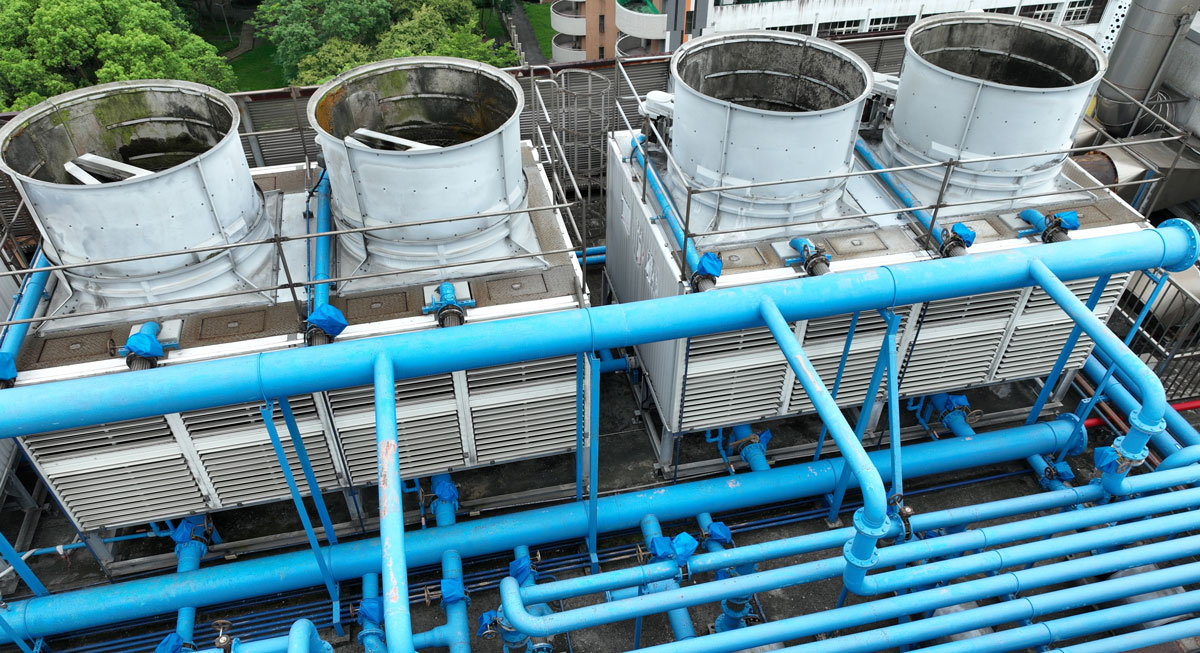
With cooling towers tucked away on roofs or behind facilities, it easily becomes an out-of-sight, out-of-mind situation. That is until the day the air conditioning fails or a production line grinds to a halt. For facility managers and industrial operators, the cooling tower is the silent mainstay of the entire infrastructure, tirelessly rejecting heat to keep operations running smoothly.
Every cooling tower has a finite lifespan, routine maintenance can extend it, but eventually repairs stop being strategic and start becoming a financial drain.
If you are experiencing any of the following, you should consider upgrading to a new cooling tower:
- An increase in energy bills and the consumption of electricity.
- Your repair logs are steadily increasing with no end in sight.
- The thermal performance of your tower is no longer as efficient as it once was
- An increase in water and chemical consumption in a typical period
- Your cooling tower is so old that replacement parts are hard to come by
Sign #1: Escalating maintenance costs
Start with your maintenance logs. How often are repairs interrupting workflow?
Landover often sees clients delay replacing 20-30-year-old cooling units due to the perceived lower incremental cost of repair versus capital expenditure. Yet, examining the last two years of ledger entries may show that accumulated repair costs could have largely covered a new, high-efficiency system.
The chain reaction failure
A cooling tower is a synergistic system. When one major component starts to fail due to age, such as the gear drive or fan motor, it often puts undue stress on the rest of the assembly. If your maintenance logs show a revolving door of issues you aren’t just maintaining a tower. You are fighting a losing battle against physics.
The hidden costs
When calculating maintenance costs, many managers only look at the invoice. To get a true sense of the drain on your resources, you also need to consider:
- Internal Labor
- Emergency Premiums
- Operational Downtime
The 50% Rule
A simple guideline: if the cost of an upcoming repair plus last year’s repair costs exceeds 50% of the price of a new unit, replacement is usually the smarter financial decision.
Sign #2: Widespread structural corrosion
Cooling towers are, by design, high-moisture environments. They are constantly exposed to oxygen and fluctuating temperatures as well as chemical treatments. All of this combined is the perfect recipe for oxidation.
However, there is a massive difference between surface-level discoloration and structural compromise. When the Landover team does inspections, we look for the Point of No Return corrosion that signals the end of a tower’s service life.
The scourge of white rust
Many older towers are constructed from galvanized steel coated in zinc. If the water chemistry is not maintained, or if the tower is simply reaching a certain age, “white rust” can occur. This is a waxy, white deposit that indicates accelerated zinc deterioration and shortens the tower’s liftspan.
When a leak becomes a collapse
A small basin leak may seem manageable. But water is heavy. If corrosion extends to the support joists, internal columns, or the fan deck, you aren't just looking at a plumbing problem; you’re looking at a potential structural collapse.
Modern alternatives
One of the strongest arguments for replacement over repair is the advancement in materials. Modern towers often utilize:
- Fiberglass Reinforced Polyester
- Stainless Steel
- Engineered Plastics
If your current tower looks like it belongs in a shipwreck, the structural risk likely outweighs any savings found in another patch job. Replacing a corroded tower is a proactive safety measure that protects your roof, your business, your personnel, and your peace of mind.
Sign #3: Dropping thermal performance
A cooling tower’s primary job is simple: make hot water cold again through evaporation. Efficiency is measured by “approach”, which is the difference between the cooled water temperature and the ambient wet-bulb temperature.
As a tower ages, that approach widens. If your system was designed to deliver 85°F water but is consistently struggling to get below 90°F, your entire facility is paying the price.
Scaling and fouling
The most common reason for a drop in performance is the degradation of the fill media. The fill provides the surface area where water and air meet. Over time, calcium deposits (scale), algae, and debris clog these narrow passages.
- Reduced Surface Area: When the fill is clogged, water channels together ("channeling") instead of spreading out, drastically reducing evaporation.
- Airflow Resistance: A fouled tower forces the fan motor to work harder to push air through the debris, leading to higher electricity consumption for lower cooling output.
The chiller strain effect
The cooling tower doesn't operate in a vacuum; it’s part of a loop. When the tower fails to provide sufficiently cool water, the chiller at the other end of the line has to work harder.
For every degree increase, energy consumption can increase by 2% to 3%. Over time, this adds thousands of dollars to your utility bill, costs that are often hidden because they show up on an electric bill instead of a repair bill.
Cleaning isn’t always enough
While our services include professional cleanings, there comes a point where the fill is so brittle, or the distribution nozzles are so degraded, that the material literally begins to disintegrate. If you’re finding pieces of old fill in your strainers, the internal surface area is vanishing. At this stage, the tower is no longer a heat exchanger; it’s a bottleneck.
Sign #4: Obsolete parts and “Frankenstein” units
Most cooling towers are designed to last 15-20 years, but many facilities push them well into their third or fourth decade. A problem arises when the OEM either goes out of business or stops producing components for that particular model.
Temporary fixes can buy time, but relying on discontinued components means operating on borrowed time, especially during peak summer demand.
Sign #5: High water and chemical consumption
The final telltale sign isn’t something you see in the tower itself. It’s something you see on your utility and chemical treatment bills. A cooling tower is essentially a massive water processor, and an inefficient one is a massive water waster.
Excessive drift and hidden leaks
Older towers suffer from brittle or sagging drift eliminators, which allow water droplets to escape into the atmosphere as mist. This isn’t just water loss; it’s treated water, which means you’re spraying expensive chemicals into the air. Additionally, aging basins often develop hairline fractures or seam leaks that can bleed hundreds of gallons of water into the building’s drainage system unnoticed.
The Bottom Line
A modern replacement can reduce water consumption by up to 20%. In an era of rising utility costs and sustainability mandates, an old, thirsty tower is a major financial liability.
Making the executive decision
Deciding to replace a cooling tower is a significant capital investment, but it is one that pays dividends. When you tally up the escalating maintenance costs, the structural risks of corrosion, the energy lost to poor thermal performance, and the headache of sourcing obsolete parts, the cheapest option is often to start fresh.
At Landover Cooling Tower Service, we help facility managers make data-driven decisions. A new tower isn't just a replacement; it’s an upgrade to your facility’s heart. Contact us today to see if your unit should be replaced.